
Portfolio view
Where is recruiting movement changing?
Current signalMovement slowed at one study
Primary patternSite review backlog
Next decisionConfirm site operating plan
Follow aggregate movement across studies, sites, sources, blocker categories, and close reasons without entering patient-level recruiting workspaces.
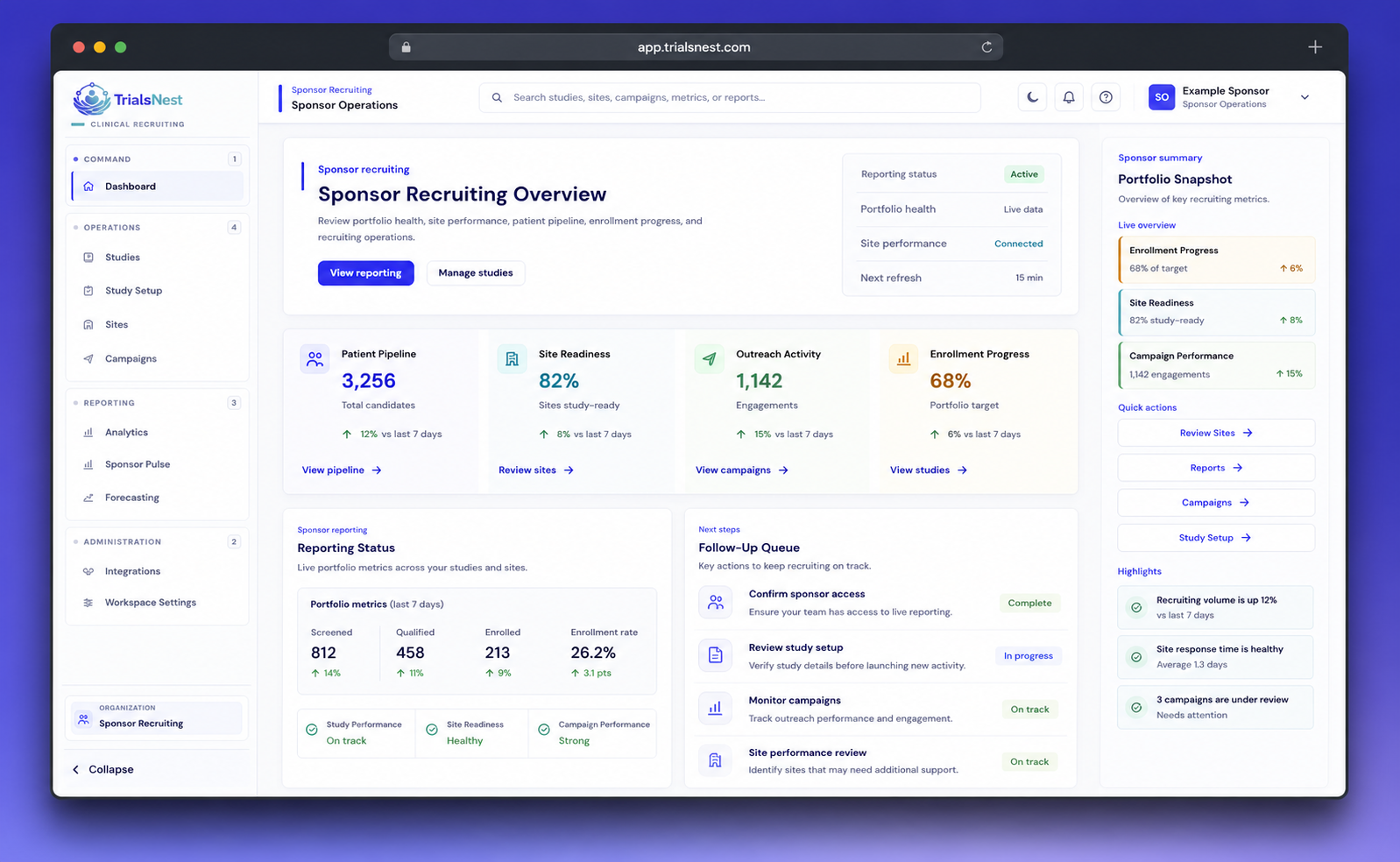
Sponsors need more than a lead count. The reporting view should connect movement to an operating pattern, owner, and decision.
The useful proof is not a large headline number. It is a consistent record of movement, blocker category, owner, and decision across the reporting cadence.
The update identifies where movement changed and separates a current operating pattern from normal variation.
The sponsor sees the blocker category and responsible operating team while the site retains its private recruiting workspace.
The reporting conversation connects source activity to useful workflow movement instead of treating lead volume as the outcome.
These fictional examples illustrate workflow evidence and are not customer testimonials, performance results, or enrollment claims.
Switch perspectives to see how an aggregate blocker becomes a site-owned next action. The sponsor view never exposes patient details.
The sponsor view begins with study- and site-level inquiry movement, not patient identity or submitted answers.
A structured inquiry enters the coordinator queue.
Sponsors can understand aggregate completion and review movement without seeing patient-level prescreen responses.
The study team receives organized answers for review.
Sponsor reporting can identify aggregate review delays and decision needs without exposing coordinator notes or patient records.
The reviewed inquiry moves to follow-up, records, or a documented close reason.
Sponsors can see aggregate readiness blockers and site-level trends, while document contents remain outside the sponsor view.
The site can see whether the inquiry is ready to move toward scheduling.
The sponsor view shows site-level scheduling movement and delay categories, not individual appointments or contact details.
The patient and site receive a clear scheduling status.
Sponsor Pulse can summarize movement, source quality, site blockers, close-reason trends, owners, and next actions at an aggregate level.
Sponsors receive aggregate movement, blockers, and next actions.
These are workflow outcomes—not unsupported performance claims.
Separate site-level operating delay from normal recruiting variation.
Connect source activity to review movement, blockers, and documented outcomes.
Pair the operating signal with the team responsible for the next action.
Package movement, close reasons, and decisions into a sponsor-safe summary.
Sponsor reporting is designed around aggregate study, site, source, movement, blocker, and next-action signals. Private patient information and research-team work remain outside the sponsor view.
Use these practical resources to compare approaches and define the operating signals your team needs.
Start with the sponsor reporting guideQuestions to use when comparing recruiting visibility and operating context.
A sponsor-focused look at metrics, movement, blockers, and next actions.
A practical starting point for structuring recurring sponsor updates.
Book a focused sponsor workflow demo built around the studies, sites, and reporting cadence your team manages today.