
Recruitment call-script QA helps teams standardize first-contact language, protect privacy boundaries, avoid eligibility promises, and route medical or consent-adjacent questions correctly.
In this guide
Key points
First contact is a control point
The first call after a patient submits interest can build trust or create expectation drift. A useful script gives coordinators consistent language while preserving space for approved workflow judgment.
FDA's recruiting guidance describes receptionist scripts as a common first-contact path and says IRBs should have assurance that personal and sensitive information gathered through those procedures will be appropriately handled. That makes the script an operating control, not just a convenience document.
Review the script for boundaries
The script should avoid eligibility promises, medical advice, study-benefit claims, and improvised consent language. It should also avoid collecting detailed sensitive information unless the approved workflow requires it at that step.
HHS explains the HIPAA minimum necessary standard as limiting use, disclosure, and requests for protected health information to what is needed for the purpose. Recruitment call scripts should reflect the same practical discipline: ask what the step requires, then route deeper review appropriately.
Tie QA to queue evidence
Script QA should not stop at a document review. Compare the script against actual repeated patient questions, escalation volume, no-response records, incomplete prescreens, and close reasons.
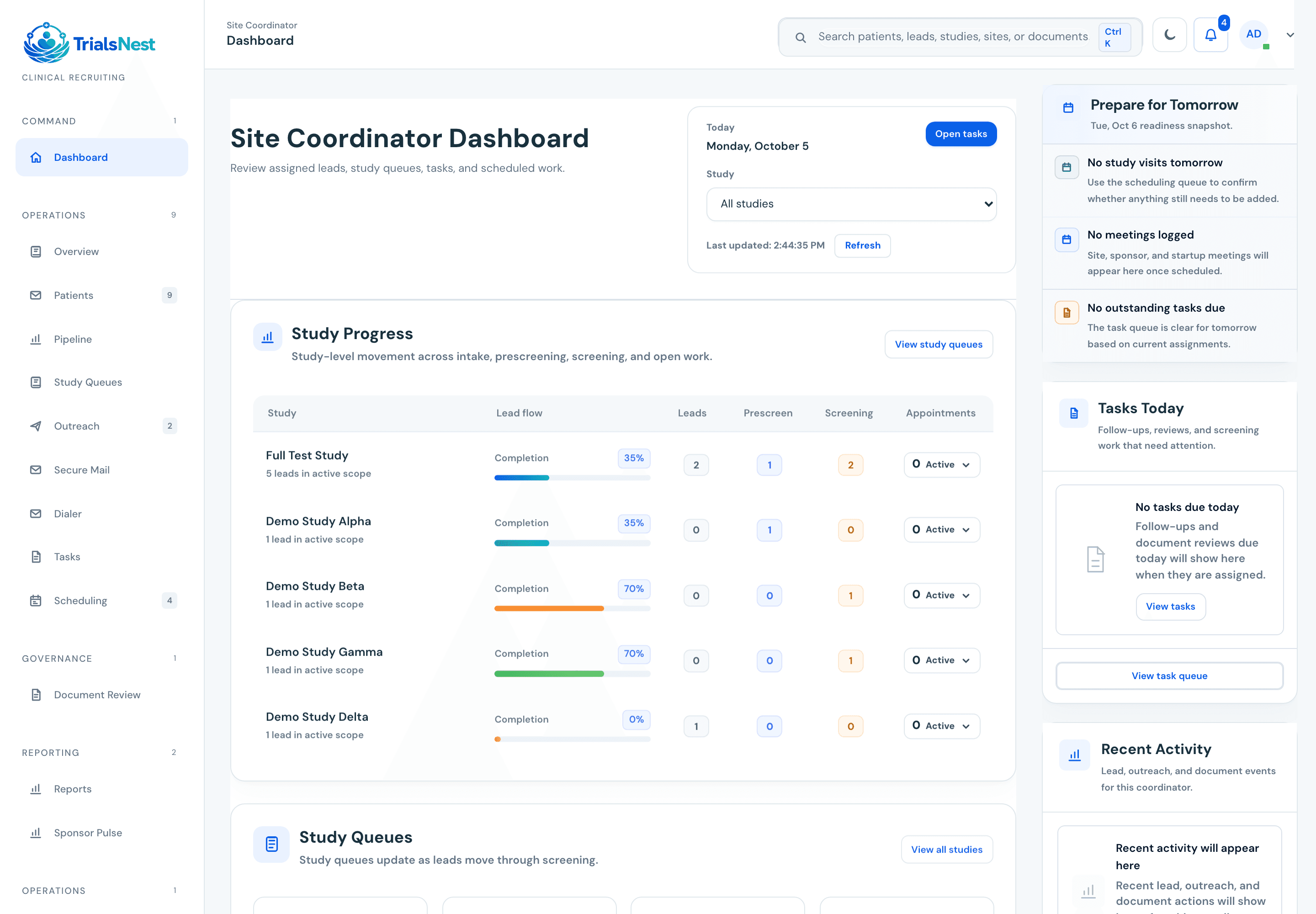
TrialsNest can support that review by keeping source, owner, status, next action, escalation, and close reason connected instead of buried in free-text notes.
Case-style example
A three-site study uses three different first-contact scripts. One coordinator says a patient qualifies, another asks for detailed medication history immediately, and another only confirms callback timing.
Coordinator note
The script should make the first call easier, not turn coordinators into improvisers. If every coordinator explains the process differently, the source quality report will be noisy too.
Starting with detailed medical questions
A first contact should not jump into sensitive detail before the patient understands who is calling, why, and what the study-team review path looks like.
No escalation lane
Questions about protocol interpretation, consent language, risk, study benefit, or medical judgment should have a named escalation route instead of being answered from memory.
Checklists and questions for your team
Decision checklist
The first lines should identify the caller, the study or inquiry, and the reason for contact without pressure or eligibility promises.
Mark which questions are coordinator-owned, which are approved prescreen prompts, and which require escalation before response.
The script should end with what happens next, who owns it, expected timing, and how the patient can ask questions or stop communication.
Before you start
Questions for your team
Ways to use this guide
Compare it with the real queue
Read it next to the way your team already works. The gaps usually show up around ownership, missing records, follow-up timing, or sponsor-update prep.
Mark the handoffs
For each section, ask where the work changes hands. If the handoff depends on memory, a spreadsheet tab, or a buried message, that is probably worth fixing.
Leave with one operating change
The guide should point to one next status, owner, report field, review cadence, or patient-facing boundary that gets clearer.
Common questions
What should teams know about clinical trial recruitment call script?
Recruitment call-script QA helps teams standardize first-contact language, protect privacy boundaries, avoid eligibility promises, and route medical or consent-adjacent questions correctly. The practical value is in connecting the concept to ownership, follow-up, records readiness, scheduling, reporting, and clear next actions.
Who is this resource written for?
This resource is written for research sites sorting through practical questions around clinical trial recruitment call script and the workflow decisions that usually come with it.
Does this guide replace study-team review or medical advice?
No. TrialsNest resources are educational and operational. They do not provide medical advice, diagnosis, treatment, emergency care, or final clinical trial eligibility decisions.
How would a team use this workflow guidance in practice?
Use it to compare the current workflow with what actually happens day to day: where leads wait, where records get lost, where follow-up slows down, and what needs a clearer owner. The best next step is to turn the article takeaways into a short review checklist for clinical trial recruitment call script.
Sources and editorial notes
Published . Reviewed by TrialsNest clinical operations review on .
Operational call-script review guidance only. Scripts, prescreen questions, consent support, and participant communication should follow sponsor, IRB, investigator, and site-approved requirements.
- Recruiting Study Subjects — FDA
- Minimum Necessary Requirement — HHS Office for Civil Rights
This information is educational. Your study team makes medical, eligibility, and enrollment decisions.
TrialsNest can organize intake, prescreening, and workflow context, but it does not make final eligibility, enrollment, treatment, or medical decisions.
Sponsor-ready updates should show source quality, movement, blockers, and next actions without becoming a broad patient-detail workspace.
These resources explain clinical recruiting workflows and buying decisions. Sensitive study details belong in the appropriate secure workflow.
See TrialsNest in action
Bring this workflow into one place.
Manage inquiries, follow-ups, records, and visits. Keep sponsors updated on progress.
Keep reading
Clinical trial patient communication checklist for research sites
A patient communication checklist for research sites standardizing follow-up, records requests, scheduling, and review boundaries.
Patient-facing clinical trial pages: set better expectations
A practical guide for research sites writing patient-facing trial pages with clearer fit language, visit expectations, consent boundaries, and next steps.
Site recruitment workflow for clinical trials
See the site recruitment workflow for clinical trials, from patient intake and records readiness to patient recruitment tracking dashboards, scheduling, and sponsor updates.
Plain-language recruitment materials site review guide
Plain-language recruitment materials should help people understand the study process, next step, and review boundary without implying eligibility, enrollment, or medical benefit.