
Before increasing recruitment ad spend, clinical trial teams should verify whether the real constraint is traffic, source quality, follow-up speed, records readiness, or scheduling capacity.
In this guide
Key points
Do not confuse more traffic with more progress
When enrollment is behind, increasing ad spend can feel like the fastest lever. Sometimes it is. But if the site workflow cannot convert existing interest into reviewable next steps, more traffic may only create more stale leads.
The first review should separate traffic from movement. A source that creates many inquiries but few responsive, reviewable, or scheduling-ready patients may be creating operational drag rather than enrollment progress.
FDA's diversity action plan guidance reinforces the broader point that enrollment planning should be intentional. Recruitment teams need to know which sources are helping the study reach and support the intended population, not only which sources create the most form fills.
Inspect source quality before budget
A source-quality review should compare new inquiries, first contact completed, prescreen completion, reviewable candidates, records-needed candidates, scheduling-ready patients, scheduled visits, no-response closes, and not-a-fit closes.
This keeps sponsors and sites from rewarding channels that look good in campaign dashboards but create low operational value after the handoff.
The review should also preserve local site context. A source may perform well at one location and poorly at another because geography, visit burden, referral patterns, or coordinator capacity differ.
Diagnose no-response patterns
No-response leads can mean the source is low intent, the response time is too slow, the patient-facing page is unclear, the contact method is mismatched, or the visit expectations were not obvious enough before the inquiry.
Each cause requires a different fix. Increasing spend before diagnosis can make the wrong problem larger.
A weekly no-response review should include source, study, location, first-attempt time, number of contact attempts, patient-facing page used, and close reason.
Make the budget decision from workflow evidence
If source quality is low, revise targeting, creative, or source mix. If response is slow, fix queue ownership and first-action timing. If prescreens are incomplete, simplify the next step. If records are the blocker, improve records-readiness workflow. If scheduling is the blocker, review capacity and visit-window communication.
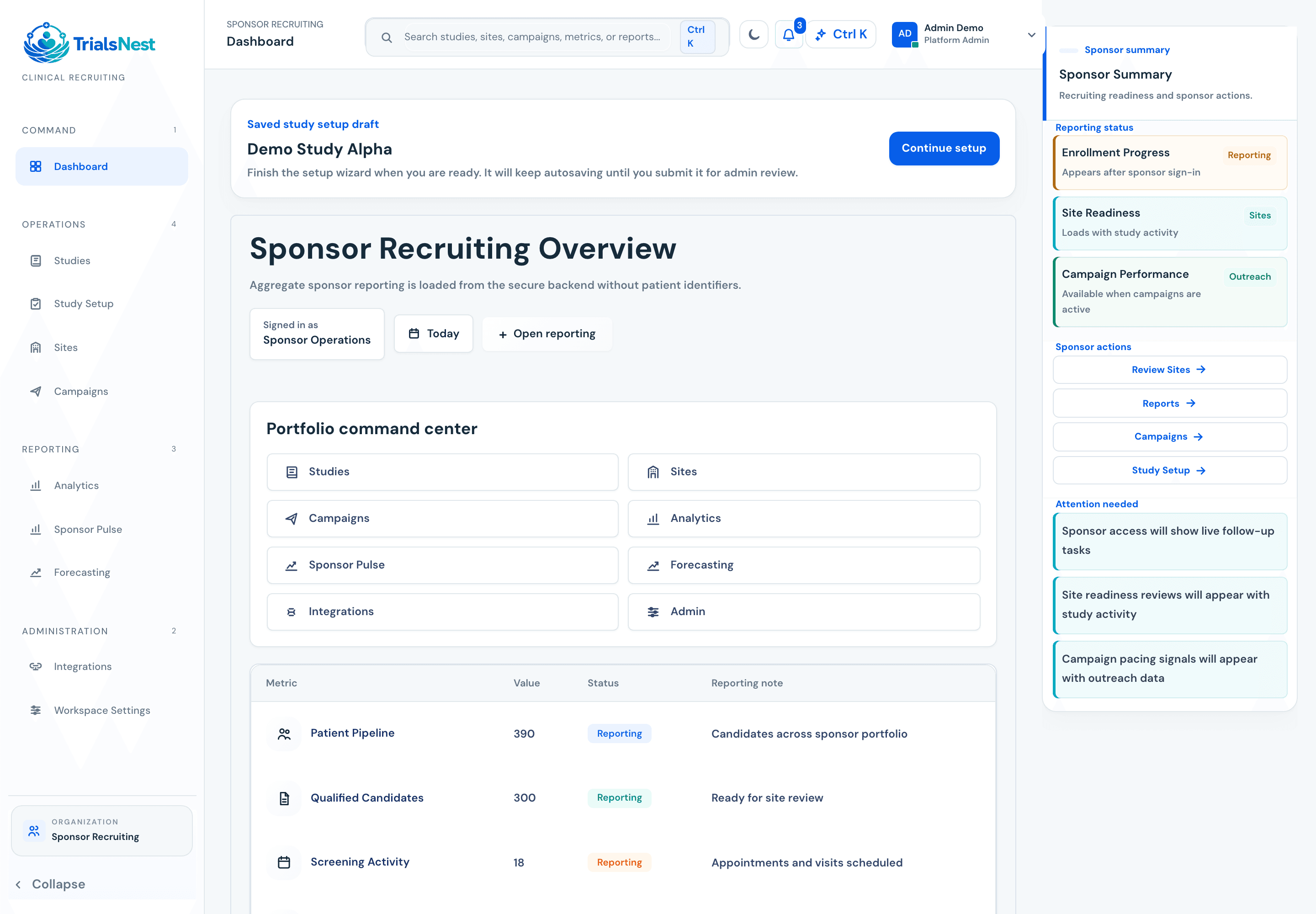
TrialsNest can support this decision by keeping recruitment source, status, owner, blocker, records readiness, scheduling movement, and sponsor-ready reporting in the same operating view.
The goal is not to avoid ad spend. The goal is to spend after the team knows which part of the recruiting system is actually constrained.
A useful sponsor review scenario
A sponsor reviews source movement and sees that one channel has volume but weak scheduled movement, while another is slower but produces stronger reviewable fit.
Sponsor operating note
clinical trial recruitment ad spend should help a sponsor decide what to ask next: source adjustment, site support, criteria clarification, stale-lead review, or reporting cadence. Counts matter most when they lead to an action.
Reading volume as quality
Source volume can hide weak reviewable fit, missing records, slow follow-up, or site capacity issues.
Letting reports become patient-detail workspaces
Sponsor visibility should stay focused on movement, blockers, source quality, close reasons, and next actions.
Checklists and questions for your team
Decision checklist
Name whether the update should change source mix, site support, criteria language, or cadence.
Keep sponsor reporting aggregate and action-oriented rather than patient-specific.
Every recurring update should end with a named action or explicit no-change decision.
Before you start
Questions for your team
Ways to use this guide
Bring it to the next sponsor review
Use clinical trial recruitment ad spend to ask what changed, what stalled, and which decision needs an owner before the next update.
Check whether the report creates action
If the meeting ends with only totals, the agenda still needs source quality, blockers, dates, and next actions.
Keep the boundary clean
Use aggregate movement and blocker patterns rather than turning sponsor visibility into patient-detail review.
Common questions
What should teams know about clinical trial recruitment ad spend?
Before increasing recruitment ad spend, clinical trial teams should verify whether the real constraint is traffic, source quality, follow-up speed, records readiness, or scheduling capacity. The practical value is in connecting the concept to ownership, follow-up, records readiness, scheduling, reporting, and clear next actions.
Who is this resource written for?
This resource is written for sponsors sorting through practical questions around clinical trial recruitment ad spend and the workflow decisions that usually come with it.
Does this guide replace study-team review or medical advice?
No. TrialsNest resources are educational and operational. They do not provide medical advice, diagnosis, treatment, emergency care, or final clinical trial eligibility decisions.
How would a team use this workflow guidance in practice?
Use it to compare the current workflow with what actually happens day to day: where leads wait, where records get lost, where follow-up slows down, and what needs a clearer owner. The best next step is to turn the article takeaways into a short review checklist for clinical trial recruitment ad spend.
Sources and editorial notes
Published . Reviewed by TrialsNest clinical operations review on .
Operational recruitment-budget guidance for sponsors, CROs, and sites. It does not provide medical advice or recommend patient targeting that bypasses approved materials or study-team review.
- Diversity Action Plans to Improve Enrollment of Participants from Underrepresented Populations in Clinical Studies — FDA
- ClinicalTrials.gov data element definitions — ClinicalTrials.gov
- Google guidance on helpful, reliable content — Google Search Central
This information is educational. Your study team makes medical, eligibility, and enrollment decisions.
TrialsNest can organize intake, prescreening, and workflow context, but it does not make final eligibility, enrollment, treatment, or medical decisions.
Sponsor-ready updates should show source quality, movement, blockers, and next actions without becoming a broad patient-detail workspace.
These resources explain clinical recruiting workflows and buying decisions. Sensitive study details belong in the appropriate secure workflow.
See TrialsNest in action
Bring this workflow into one place.
Manage inquiries, follow-ups, records, and visits. Keep sponsors updated on progress.
Keep reading
Clinical trial recruitment source quality: what sites should measure
A guide for measuring recruitment source quality beyond lead volume, including responsiveness, prescreen fit, scheduled visits, and stalled leads.
Rescue planning for an under-enrolling clinical trial
A rescue-planning framework for under-enrolling clinical trials covering source quality, site execution, records blockers, visit burden, and sponsor decisions.
Clinical trial recruitment software resources
Resources for teams comparing clinical trial recruitment software, patient recruitment software, dashboards, workflow coverage, implementation plans, and ROI.
Clinical trial recruitment software for CRO clinical operations teams
CRO teams need recruitment software that explains where study execution is slowing down across sites, sources, records, follow-up, scheduling, and sponsor updates. The best system supports oversight without taking ownership away from site teams.