
Transparent trial communication helps patients understand what is being studied, what participation may involve, what is still unknown, and how screening decisions are made.
In this guide
Key points
Trust starts before the first form
Patients are more likely to continue a research conversation when the process feels visible and accountable. Public study registration, current recruitment status, clear expectations, and plain-language study summaries all contribute to that first impression.
ClinicalTrials.gov is both a registry and a results information database. As of May 20, 2026, it listed 585,919 registered studies and 78,185 studies with posted results. Not every registered study is legally required to post results, but the difference is one reason patients and research teams care about transparency.
Compliance language is not enough for patients
A public registry record is important, but it may not answer a patient's immediate questions. People usually want to know what the study is generally about, who may be considered, what visits may involve, whether travel is required, and what happens after they submit interest.
A recruitment page can support transparency by translating process details without turning them into medical claims. For example, use 'This study is evaluating an investigational option' instead of language that implies treatment benefit or guaranteed access.
Use a transparent recruitment checklist
Keep public study status current. Explain that prescreening is not enrollment. Separate study participation from regular medical care. Clarify expected visits and time commitment. Explain privacy and coordinator follow-up. Link to public registry information when appropriate.
Research sites should also make close reasons and next steps clear internally. If patients are not a fit, cannot be reached, are missing records, or need study-team review, the recruiting workflow should show that status instead of leaving the patient in an ambiguous queue.
Make transparency operational
A sponsor with multiple open studies can publish a plain-language guide explaining how screening works, what prescreening means, and why final eligibility stays with the study team. That content can answer patient questions, support SEO, and reduce low-fit submissions because expectations are clearer.
TrialsNest can support this by keeping patient-facing language, coordinator workflow, and sponsor-safe recruitment reporting aligned. The strongest trust signal is consistency: what the patient reads, what the coordinator does, and what the sponsor sees should describe the same process.
Use transparency to reduce low-fit confusion
Transparent recruitment content should help patients understand whether a study is worth discussing before they share detailed information. That means explaining the public registry record, the current recruitment status, the expected next step, and the difference between public interest and study-team review.
Sites can also review recurring close reasons to see where public expectations are unclear. If many inquiries stall because of visit burden, location, records, or misunderstood criteria, the recruitment page needs clearer expectation-setting rather than only more traffic.
Sources used for this explainer
ClinicalTrials.gov trends and charts: https://clinicaltrials.gov/about-site/trends-charts
ClinicalTrials.gov reporting requirements: https://clinicaltrials.gov/policy/reporting-requirements
FDA role in ClinicalTrials.gov information: https://www.fda.gov/science-research/clinical-trials-and-human-subject-protection/fdas-role-clinicaltrialsgov-information
A queue-level example
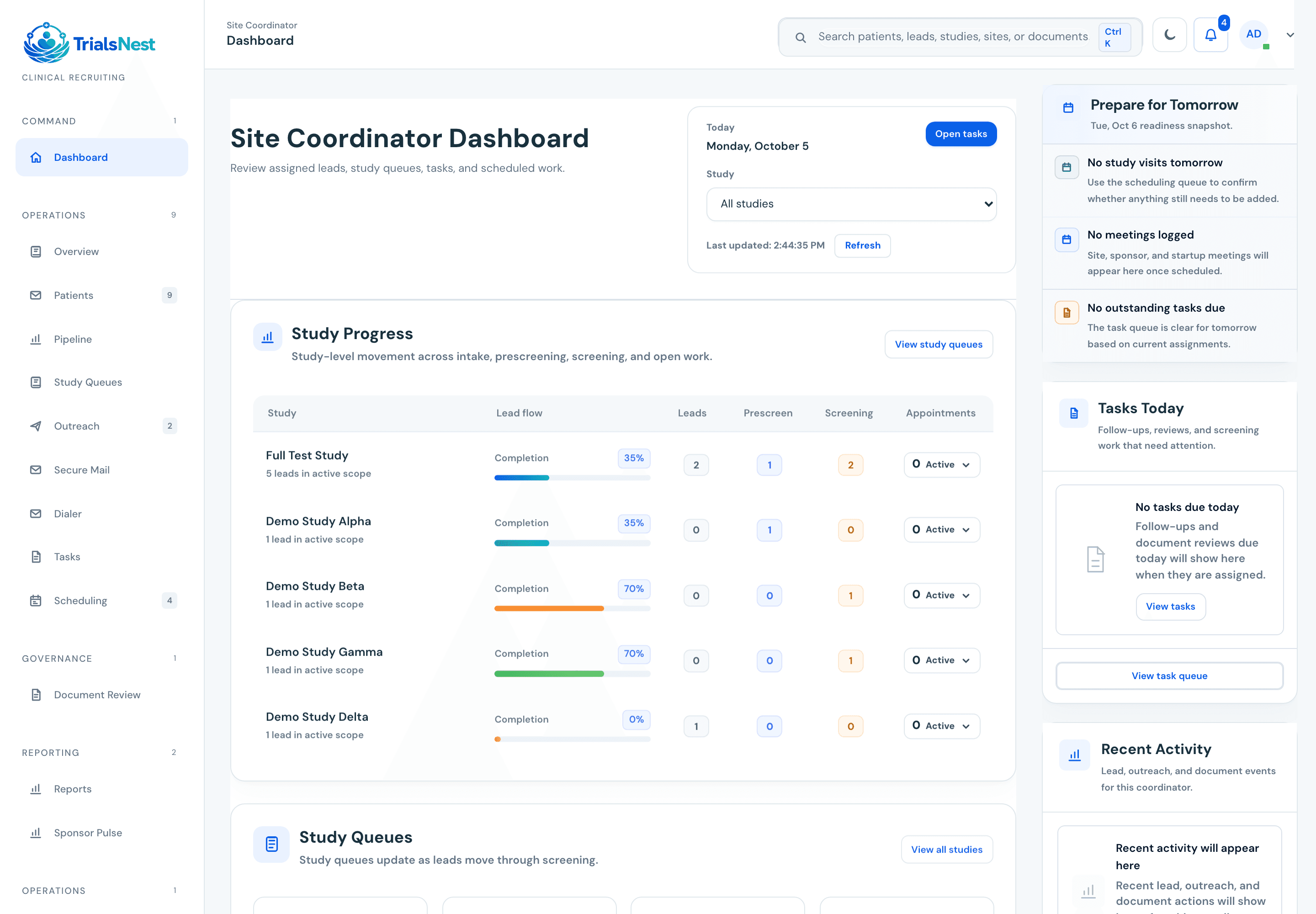
A coordinator opens the queue and can immediately see which lead needs follow-up, which one is waiting on records, and which one is ready for scheduling review.
Operator's note
Use clinical trial transparency beside the real workflow. The page is strongest when it helps a team name the owner, blocker, source-quality issue, records gap, scheduling constraint, or sponsor update that needs attention.
Treating the guide as a static document
The operational value appears when the guidance changes a queue, meeting agenda, dashboard, or handoff.
Adding detail without ownership
More fields do not help if nobody owns the next action or review point.
Checklists and questions for your team
Decision checklist
Can the next action be found without searching notes, inboxes, or spreadsheet tabs?
Does the workflow create a natural weekly or daily review point?
Can the operating record become a clean update without manual reconstruction?
Before you start
Questions for your team
Ways to use this guide
Compare it with the real queue
Read it next to the way your team already works. The gaps usually show up around ownership, missing records, follow-up timing, or sponsor-update prep.
Mark the handoffs
For each section, ask where the work changes hands. If the handoff depends on memory, a spreadsheet tab, or a buried message, that is probably worth fixing.
Leave with one operating change
The guide should point to one next status, owner, report field, review cadence, or patient-facing boundary that gets clearer.
Common questions
What should teams know about clinical trial transparency?
Transparent trial communication helps patients understand what is being studied, what participation may involve, what is still unknown, and how screening decisions are made. The practical value is in connecting the concept to ownership, follow-up, records readiness, scheduling, reporting, and clear next actions.
Who is this resource written for?
This resource is written for research sites sorting through practical questions around clinical trial transparency and the workflow decisions that usually come with it.
Does this guide replace study-team review or medical advice?
No. TrialsNest resources are educational and operational. They do not provide medical advice, diagnosis, treatment, emergency care, or final clinical trial eligibility decisions.
How would a team use this workflow guidance in practice?
Use it to compare the current workflow with what actually happens day to day: where leads wait, where records get lost, where follow-up slows down, and what needs a clearer owner. The best next step is to turn the article takeaways into a short review checklist for clinical trial transparency.
Sources and editorial notes
Published . Reviewed by TrialsNest editorial review on .
This guide explains recruitment work and questions to discuss with your team.
This information is educational. Your study team makes medical, eligibility, and enrollment decisions.
TrialsNest can organize intake, prescreening, and workflow context, but it does not make final eligibility, enrollment, treatment, or medical decisions.
Sponsor-ready updates should show source quality, movement, blockers, and next actions without becoming a broad patient-detail workspace.
These resources explain clinical recruiting workflows and buying decisions. Sensitive study details belong in the appropriate secure workflow.
See TrialsNest in action
Bring this workflow into one place.
Manage inquiries, follow-ups, records, and visits. Keep sponsors updated on progress.
Keep reading
Patient reimbursement pages that reduce confusion before screening
A practical checklist for explaining clinical trial reimbursement, travel support, parking, lodging, and payment timing without creating misleading expectations.
Plain-language recruitment materials site review guide
A site review guide for plain-language recruitment materials, patient expectations, review boundaries, and approved next steps.
Clinical trial recruitment software resources
Resources for teams comparing clinical trial recruitment software, patient recruitment software, dashboards, workflow coverage, implementation plans, and ROI.
Best patient recruitment software for clinical trials
The best patient recruitment software for a clinical trial site is usually the system that helps the team act on patient interest, not just collect more form fills.