
Community referral partners and paid recruitment channels should be compared by patient understanding, source quality, follow-up movement, and site workload rather than raw inquiry volume alone.
In this guide
Key points
Start with the same source-quality standard
Imagine a research site running one active study with two major patient sources: paid digital campaigns and community referral partners. The paid campaign creates more inquiries. The referral partners create fewer. At first glance, the paid channel looks stronger.
After the coordinator team reviews source quality, the picture becomes more useful. The paid source may create fast volume, while referral partners may create better-prepared conversations because patients arrive with more context.
That does not mean one source is always better. It means clinical trial recruitment channels should be compared by movement through the workflow, not by lead count alone.
What the site should track
The site should compare new inquiries, first contact completed, prescreen completed, reviewable by coordinator, records needed, scheduling-ready, closed as no response, closed as not a fit, and common patient questions.
A high-volume source may still create operational drag if many patients misunderstand location, visit burden, or broad study fit. A lower-volume referral partner may be valuable if patients arrive with clearer expectations and respond to follow-up.
The useful question is not which source created the most names. The useful question is which source created responsive, reviewable, well-informed patient interest that the site can responsibly move forward.
Set partner boundaries before outreach
Community partners should use approved materials and route study-specific questions to the research team. They should not make eligibility decisions, pressure participation, or promise study benefits.
OHRP's engagement guidance is a reminder that institutional roles matter. Teams should understand when activities could create research engagement questions and should review partner responsibilities with the sponsor, IRB, and institution as appropriate.
The Belmont Report's ethical principles also support a conservative operating posture: keep participation voluntary, respect informed decision-making, and avoid channel practices that could create undue pressure.
Case-style workflow example
A site runs paid ads for a study and also works with a local community organization. The ads generate volume, but many candidates misunderstand visit burden. The community partner sends fewer candidates, but those candidates arrive with better expectations because the partner uses approved plain-language materials and routes questions to the coordinator.
The site does not cut either source. It rewrites paid landing-page expectations, gives the referral partner approved study overview language, tags every inquiry by source, and reviews close reasons weekly.
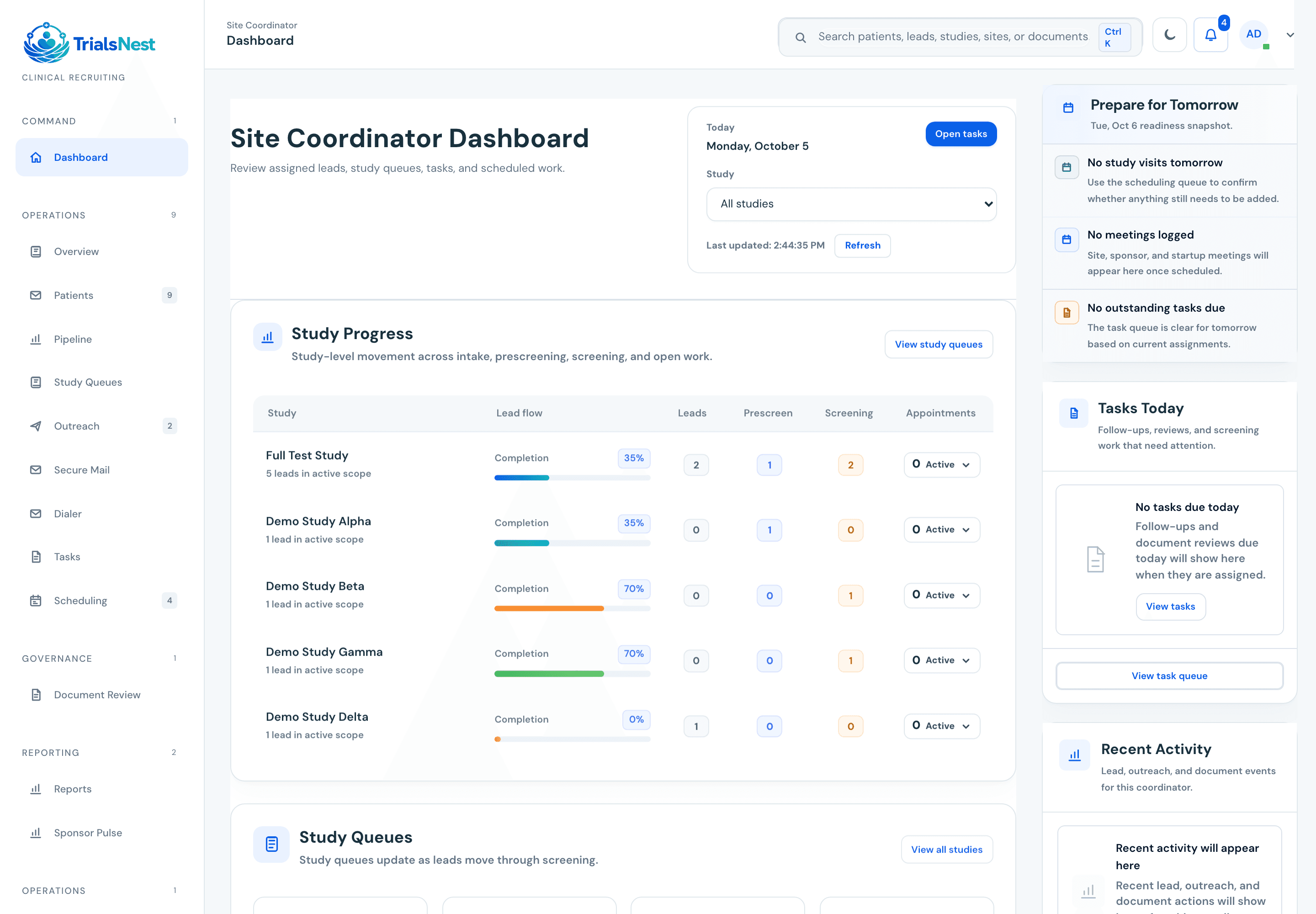
TrialsNest can support that operating model by keeping source, status, owner, blocker, next action, and close reason visible across paid and referral channels.
How to decide what to change
If paid leads are high volume but low response, the team may need clearer page expectations, faster first contact, or tighter audience targeting. If referral leads are few but high quality, the team may need more partner education, a cleaner handoff, or a broader approved partner list.
If both channels create stalled leads, the issue may not be source quality at all. The site may need better coordinator ownership, records-readiness workflow, scheduling visibility, or sponsor clarification about criteria language.
The decision should come from source-quality evidence, not channel preference. A healthy recruitment strategy can use both paid and community channels when each has clear boundaries and measurable workflow movement.
A cleaner comparison scenario
Compare each option against the same patient path: inquiry received, early fit reviewed, records pending, visit not yet scheduled, sponsor update due.
How to read the comparison
Use community referral partners clinical trials to separate jobs that often get blended together: sourcing, routing, study workflow, records readiness, scheduling, and reporting. The best answer may be a boundary, not a winner-take-all tool.
Comparing categories as if they do the same job
Referral tools, CRMs, CTMS modules, campaign vendors, and recruitment workflow platforms can overlap in language while solving different handoffs.
Ignoring what happens after patient interest
The important test is whether the team can act on the inquiry after it reaches the site.
Checklists and questions for your team
Decision checklist
Name the job this page is comparing before reviewing features.
Confirm who owns the patient, site, or sponsor handoff when work stalls.
Look for status movement, blocker reasons, and next actions, not only record counts.
Before you start
Questions for your team
Ways to use this guide
Use one messy workflow scenario
Compare options against a mixed queue with new inquiries, records gaps, stale leads, and a sponsor update due.
Ask what disappears from the spreadsheet
The best buying signal is not a feature list; it is the handoff, report, or status cleanup the team no longer has to rebuild.
Turn weak scores into rollout work
Any low score should become an implementation requirement, training need, or boundary question before selection.
Common questions
What should teams know about community referral partners clinical trials?
Community referral partners and paid recruitment channels should be compared by patient understanding, source quality, follow-up movement, and site workload rather than raw inquiry volume alone. The practical value is in connecting the concept to ownership, follow-up, records readiness, scheduling, reporting, and clear next actions.
Who is this resource written for?
This resource is written for research sites sorting through practical questions around community referral partners clinical trials and the workflow decisions that usually come with it.
Does this guide replace study-team review or medical advice?
No. TrialsNest resources are educational and operational. They do not provide medical advice, diagnosis, treatment, emergency care, or final clinical trial eligibility decisions.
How would a team use this workflow guidance in practice?
Use it to compare the current workflow with what actually happens day to day: where leads wait, where records get lost, where follow-up slows down, and what needs a clearer owner. The best next step is to turn the article takeaways into a short review checklist for community referral partners clinical trials.
Sources and editorial notes
Published . Reviewed by TrialsNest clinical operations review on .
Operational comparison for recruitment-channel planning. It does not authorize partner outreach language, eligibility decisions, participation promises, or unapproved recruitment materials.
- Engagement of Institutions in Human Subjects Research — HHS OHRP
- The Belmont Report — HHS Office for Human Research Protections
- Informed Consent FAQs — HHS Office for Human Research Protections
This information is educational. Your study team makes medical, eligibility, and enrollment decisions.
TrialsNest can organize intake, prescreening, and workflow context, but it does not make final eligibility, enrollment, treatment, or medical decisions.
Sponsor-ready updates should show source quality, movement, blockers, and next actions without becoming a broad patient-detail workspace.
These resources explain clinical recruiting workflows and buying decisions. Sensitive study details belong in the appropriate secure workflow.
See TrialsNest in action
Bring this workflow into one place.
Manage inquiries, follow-ups, records, and visits. Keep sponsors updated on progress.
Keep reading
Referral partner handoff SOP for clinical trial recruitment
A practical SOP-style playbook for managing clinical trial referral partners, including approved language, handoff boundaries, routing, tracking, and follow-up.
Clinical trial recruitment source budget review checklist
A checklist for research sites reviewing clinical trial recruitment source budget, including quality, coordinator effort, stale leads, reporting, and next-step decisions.
Clinical trial recruitment software resources
Resources for teams comparing clinical trial recruitment software, patient recruitment software, dashboards, workflow coverage, implementation plans, and ROI.
Best patient recruitment software for clinical trials
The best patient recruitment software for a clinical trial site is usually the system that helps the team act on patient interest, not just collect more form fills.