Spreadsheets list work, but they do not run it
A sheet can track patients, but it rarely keeps ownership, prescreen status, records, reminders, scheduling, and reporting reliable when volume grows.
Compare spreadsheet-based recruiting trackers with clinical trial recruitment software built for patient intake, prescreening, records readiness, scheduling, and sponsor updates.
Each capability is designed around a concrete recruiting job: assign the owner, review fit, request records, schedule the next step, or explain what changed.
A sheet can track patients, but it rarely keeps ownership, prescreen status, records, reminders, scheduling, and reporting reliable when volume grows.
A recruiting workspace ties the patient, study, source, owner, status, blocker, and next step to the same operational record.
Sponsor updates are stronger when they come from the live workflow instead of a manually refreshed tab.
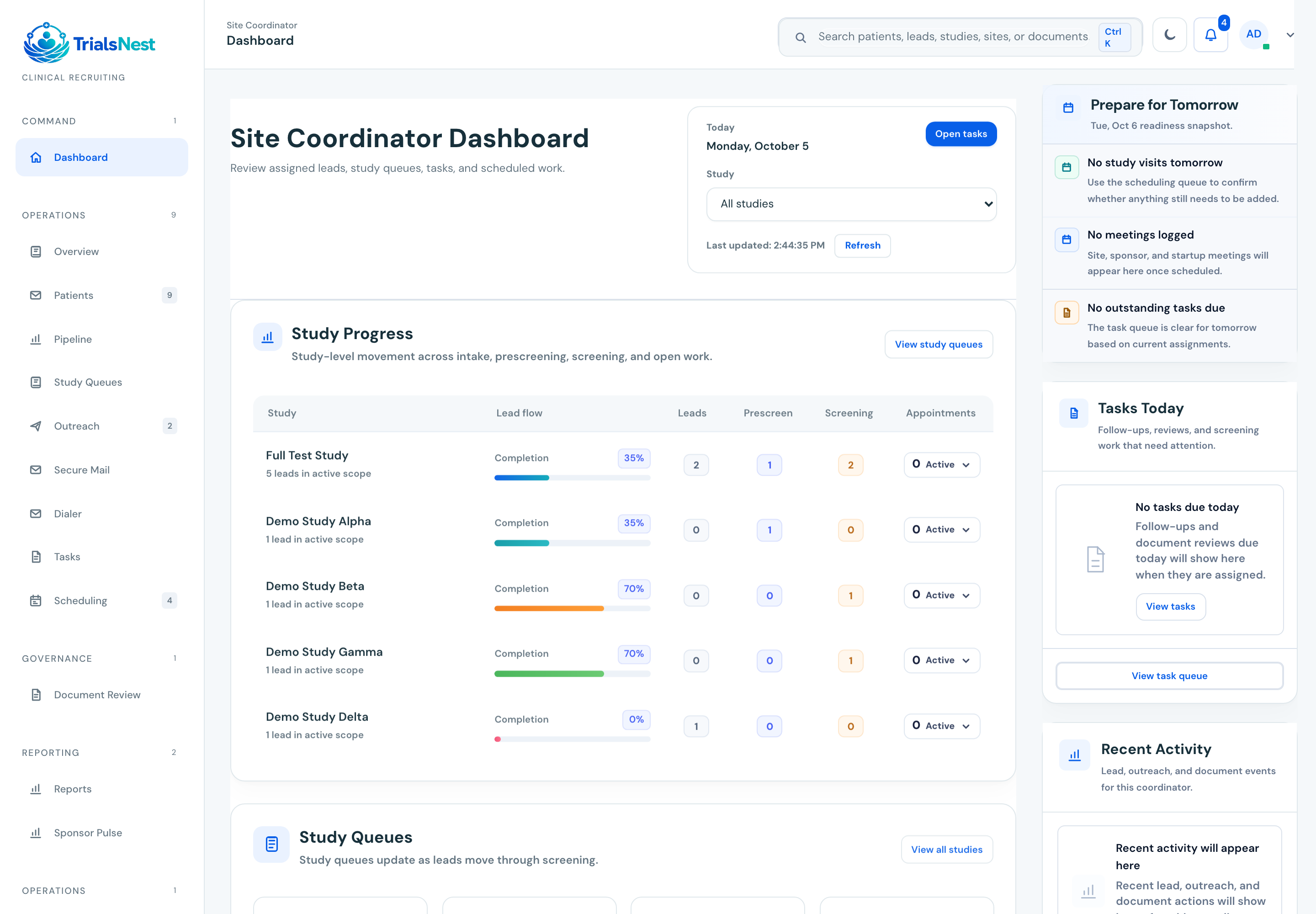
The page shows the practical product logic for buyers while keeping the language grounded in what site teams do every day.
Buyers can see the product logic before a demo: the left side shows the active recruiting record, and the right side shows how the team moves from signal to next step.
Identify where status, ownership, or records context depends on someone updating a spreadsheet by hand.
Move intake, prescreening, records, follow-up, scheduling, and reporting into one recruiting path.
Use current recruiting status to explain movement, blockers, source quality, and next steps.
Identify where status, ownership, or records context depends on someone updating a spreadsheet by hand.
Move intake, prescreening, records, follow-up, scheduling, and reporting into one recruiting path.
Use current recruiting status to explain movement, blockers, source quality, and next steps.
These pages give buyers enough context to understand the feature, then route them to a walkthrough when they are ready to see the product live.
Teams spend less time reconciling rows, email threads, and calendar notes.
Qualified patients are easier to follow from inquiry to scheduled next step.
The page captures buyers already comparing manual trackers with recruiting software.
Browse buyer guides, templates, examples, and workflow comparisons.
Review operational guidance for intake, records readiness, scheduling, and stale leads.
See reporting guides for enrollment movement, source quality, blockers, and next actions.
Compare a structured recruitment record with spreadsheet-based tracking for patient intake, prescreening, follow-up, records readiness, scheduling, and sponsor updates.
TrialsNest helps research sites organize patient inquiries, prescreening, coordinator ownership, records readiness, scheduling, and sponsor updates from one site-focused recruiting view.
Move beyond disconnected inboxes and spreadsheets with a site workflow that keeps patient status, fit, records, outreach, scheduling, and reporting in one operational view.
Each solution page points buyers toward the controls that matter when patient discovery, site execution, and sponsor reporting meet.
Workflows are shaped around patients, coordinators, site leaders, sponsors, and admins seeing the right level of detail.
TrialsNest keeps sensitive recruiting workflows aligned to the secure backend boundary instead of adding PHI handling to public pages.
Reporting is designed around aggregate progress, blockers, and next steps rather than broad patient-level exposure.
Clinical trial recruitment software vs spreadsheets is built for research sites, site networks, and clinical operations teams that need a concrete way to manage clinical trial recruitment activity, patient follow-up, and operational reporting.
No. TrialsNest supports patient discovery, prescreening organization, queue review, and site follow-up. Authorized research sites and study teams make final eligibility, screening, and enrollment decisions.
The capability connects to the broader TrialsNest workflow across patient interest, prescreening, coordinator review, records readiness, scheduling, and sponsor-safe reporting.
Walk through a real recruiting scenario, see where it fits in the platform, and decide what would matter most for your team.