Referral tools are usually handoff-focused
They help route inbound interest, but the daily recruiting work often continues elsewhere.
Understand the difference between referral management and patient recruitment software for clinical trial intake, prescreening, coordinator follow-up, and sponsor reporting.
Each capability is designed around a concrete recruiting job: assign the owner, review fit, request records, schedule the next step, or explain what changed.
They help route inbound interest, but the daily recruiting work often continues elsewhere.
Clinical trial teams need prescreening, records readiness, coordinator ownership, reminders, scheduling context, and close reasons.
Recruitment reporting is stronger when it shows what the site actually did with patient interest after the handoff.
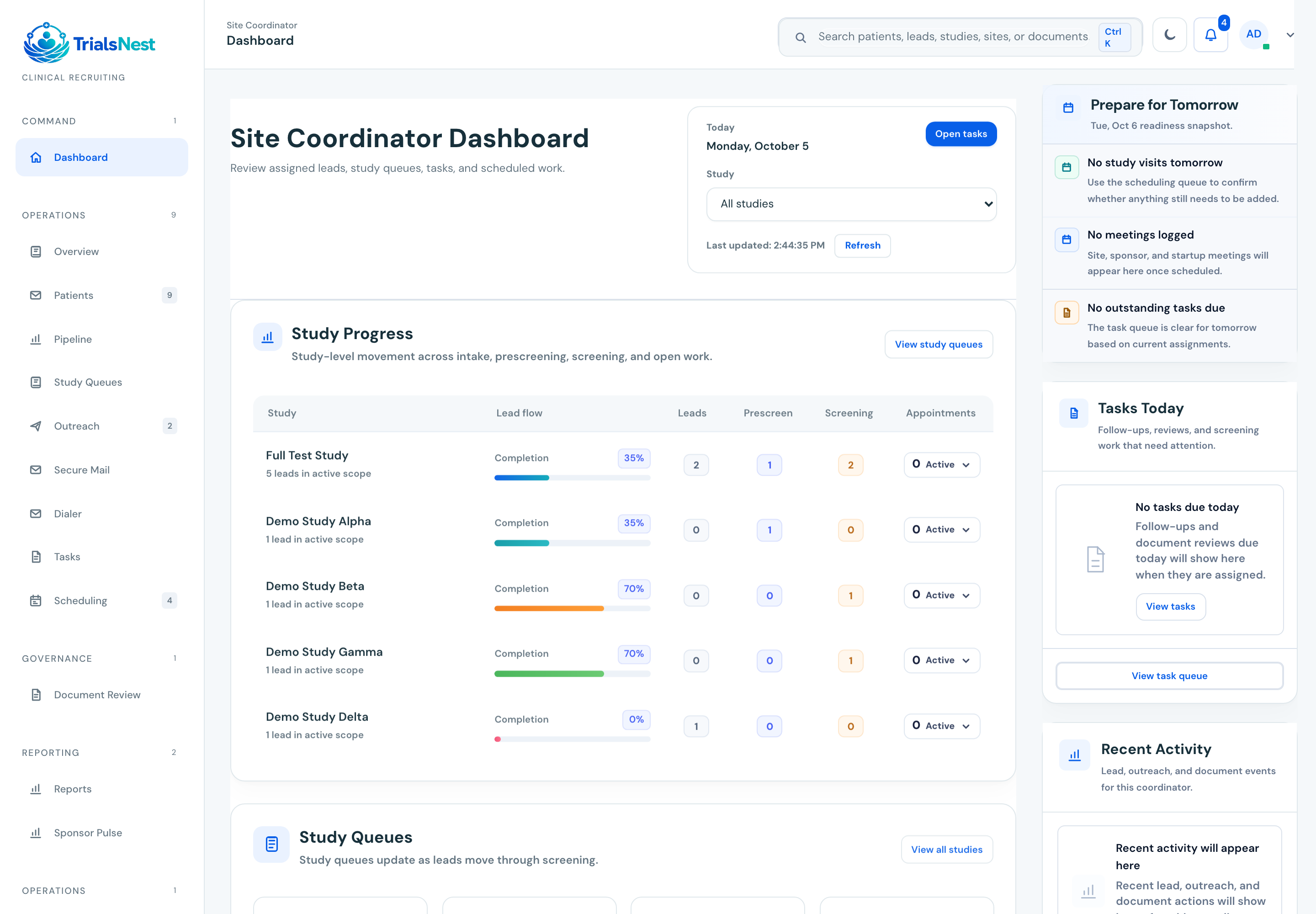
The page shows the practical product logic for buyers while keeping the language grounded in what site teams do every day.
Buyers can see the product logic before a demo: the left side shows the active recruiting record, and the right side shows how the team moves from signal to next step.
Identify where a referral starts and what study context follows the patient.
Track review, outreach, records, tasks, scheduling, and stalled leads.
Report movement and blockers from the recruiting workflow, not only the referral count.
Identify where a referral starts and what study context follows the patient.
Track review, outreach, records, tasks, scheduling, and stalled leads.
Report movement and blockers from the recruiting workflow, not only the referral count.
The preview keeps coordinator outreach, patient replies, and the next action in one safe sample conversation, matching the way TrialsNest presents messages as operational context.
Hi, I am checking in from the study team. Are mornings or afternoons better for a quick follow-up?
Afternoons are better. I also finished the item you requested in my portal.
Perfect. I marked that as received and added a reminder for the next step.
Great, I will note that afternoons are best for follow-up.
These pages give buyers enough context to understand the feature, then route them to a walkthrough when they are ready to see the product live.
Teams can distinguish routing tools from full recruitment operations software.
Coordinators can evaluate whether the product helps the daily queue.
The page targets teams comparing adjacent software categories.
Browse buyer guides, templates, examples, and workflow comparisons.
Review operational guidance for intake, records readiness, scheduling, and stale leads.
See reporting guides for enrollment movement, source quality, blockers, and next actions.
TrialsNest helps clinical trial sites move patient interest from discovery into prescreening, coordinator review, records readiness, scheduling, source-quality tracking, dashboard review, and sponsor reporting without rebuilding the day in spreadsheets.
TrialsNest helps research sites organize patient inquiries, prescreening, coordinator ownership, records readiness, scheduling, and sponsor updates from one site-focused recruiting view.
Use TrialsNest as a practical benchmark for evaluating patient recruitment vendors across lead quality, operational coverage, site adoption, reporting, and trust boundaries.
Each solution page points buyers toward the controls that matter when patient discovery, site execution, and sponsor reporting meet.
Workflows are shaped around patients, coordinators, site leaders, sponsors, and admins seeing the right level of detail.
TrialsNest keeps sensitive recruiting workflows aligned to the secure backend boundary instead of adding PHI handling to public pages.
Reporting is designed around aggregate progress, blockers, and next steps rather than broad patient-level exposure.
Patient recruitment software vs referral management is built for research sites, site networks, and patient recruitment teams that need a concrete way to manage clinical trial recruitment activity, patient follow-up, and operational reporting.
No. TrialsNest supports patient discovery, prescreening organization, queue review, and site follow-up. Authorized research sites and study teams make final eligibility, screening, and enrollment decisions.
The capability connects to the broader TrialsNest workflow across patient interest, prescreening, coordinator review, records readiness, scheduling, and sponsor-safe reporting.
Walk through a real recruiting scenario, see where it fits in the platform, and decide what would matter most for your team.